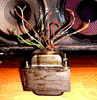
L'influence c'est plus au niveau de la réponse de l'ampli notamment à fort volume, que sur le son à proprement parler mais les deux sont liés. Concrêtement ça joue sur le temps que met l'ampli à réagir, et la compression du son quand tu pousses l'ampli. D'après ce que j'ai compris, la lampe va jouer un peu les goulots d'étranglements au niveau du voltage qui va aux tubes en fonction du courant demandé, et donc si ces derniers ont une grosse demande en courant (quand le machin est à bien fort), ça va prendre un peu plus de temps pour que la lampe puisse satisfaire à la demande, et elle va fournir un voltage un peu moins élevé.
Si tu maitrises correctement l'anglais, tu peux taper "sag" sous google. Donc en gros ça introduit une variable supplémentaire qui fait que l'ampli peut sembler plus vivant que si c'était de la diode basique.
Citation:
The rectifier: If a vacuum tube rectifier is used, sag is generated because of the internal resistance of the tube. Unlike a solid-state rectifier, a tube rectifier exhibits a fair amount of voltage drop which varies with the amount of current passing through the tube. In a class AB amplifier, the current drawn from the power supply is much greater at full power output than it is at idle. This large change in current demand causes the voltage drop across the tube rectifier to increase, which lowers the available plate supply voltage to the output tubes. This lowering of the supply voltage lowers the output power slightly in opposition to the larger input signal, making it act like a compressor. The lowered supply voltage also tends to decrease the available headroom, increasing clipping and changing the operating point of the tube dynamically. This type of sag can be emulated artificially in an amplifier with a solid-state rectifier by adding a series resistance, typically around 100 ohms or so..