Citation:
Nils Lofgren began his musical career almost four decades ago when he first joined Neil Young's band, performing on the critically-acclaimed 1970 release, After The Gold Rush and later fronting his own short lived hard rocking band, Grin. In addition to his sporadic recording and touring work with Young, over the years he has recorded and toured with Bruce Springsteen and released numerous solo outings. In recent times, Nils also set up his own Online Guitar School, which has garnered tremendous response from guitar players all over the world. Nils recent studio effort, The Loner - Nils Sings Neil, sees him paying homage to his former employer and mentor and one of our generation's most popular songwriters, Neil Young. The album features fifteen renditions of some of Young's greatest songs. Nils recently spoke to Joe Matera to discuss the new record, guitars and working for The Boss.
UG: When it came to recording The Loner: Nils Sings Neil, were you conscious of the approach you were going to use in re-interpreting Neil’s classic songs, knowing that you would also be adding your own touch to it all?
Nils Lofgren: First up, I have to state that it really was my manager Anson Smith’s idea to make this record, as I really wouldn’t have thought of it. And I didn’t know whether I’d like the idea because being a big Neil Young fan he certainly recorded all his records in fine fashion. So what I did first was to assemble about thirty songs of Neil’s. And I just started singing them for about two weeks, I didn’t record or arrange anything, I just sang the songs for hours every day. After two weeks, about a dozen of the songs started to feel like something special was going on with me as a singer and an interpreter. And it was at that point I decided it might be a good project. But I also realized the only interest I had in trying to do a record like this was if it was completely done live in the studio with no production and no overdubbing, just a performance piece with guitar or piano. So with those guidelines, it became a fun project. And with those rules I managed to get it recorded very quickly. A good friend Bill Wolf, mixed and mastered it for me in Virginia where I flew in and out to work with him while I was out on the road with Bruce.
Has Neil heard the album yet?
I don’t know. As soon as I had the tracks recorded and knew it was going to be a record, I called Neil and talked to him about it and asked him for some advice and opinions on the liner notes and things like that. But I did send him a copy of the record once it was mixed. I have heard from his wife Pegi and his manager Elliot [Roberts] but I don’t know to this day, if Neil has actually heard the record itself. I hope when he does, he will recognize it as a sincere, honest attempt to recreate his beautiful songs.
"We worked very quickly on Working On A Dream and emotionally."
You mentioned finding a special connection with some of the songs…
Yes, a lot of these songs go way back to when we were on the Tonight’s The Night tour in 1973. For example, Neil taught us Don’t Be Denied which I had never heard prior and we started playing that every night and I was playing piano. Then ten years later in 1983 we were doing the Trans tour and we started playing Don’t Cry No Tears. So some of these songs I discovered while working with Neil on the road and of course they were always favorites of mine and so I was able to get versions that felt right for me.
On the album you’re using Neil’s old Martin D-18.
Yeah I didn’t own an acoustic guitar when I did the After The Goldrush [1970] album. I played a lot of piano and sang but on a couple songs, in particular Tell Me Why and ‘Till The Morning Comes, he wanted me to play acoustic guitar and because I didn’t own one, he lent me that guitar which he had been writing on. And then at the end of the sessions, he gave it to me as a gift. And certainly it is my most treasured guitar and certainly the only appropriate guitar to use on this project.
You tend to prefer Fenders but have also played Gibsons like you did on the Trans tour with Neil Young.
For that particular tour, I had an old 1952 Les Paul Goldtop which I still have today, and which is also very similar to the “Old Black” guitar that Neil uses. At the time Neil asked me to put a Bigsby on it so I could have a wham bar sound like his “Old Black” guitar has, so that once in awhile we could have that two guitar thing going on which was more in the vein of the guitars he likes. So I used that guitar extensively on that Trans tour.
Do you also use it in the studio too?
In the studio I will use Gibsons, Fenders, anything really. I’ve also got an old Zemaitis guitar too which used to belong to James Honeyman-Scott, one of my dear friends.
James was a superb guitarist. I loved his work with The Pretenders.
Yes he was an amazing guitarist and we got to be good buddies and it [guitar] was a beautiful gift from his Peggy Sue when sadly Jimmy passed away. I used that guitar on my last record Sacred Weapon [2006] a lot. And I also use that D-18 a lot too. Both of those guitars are historic and have a lot of soul in them. Currently I’m using a lot of Gretschs on the road with Bruce because he uses a lot of Gretschs in the studio.
Speaking of Bruce Springsteen, you also played on his newest album; Working On A Dream.
Yes, I’ve done session work now on The Rising [2002] album and then of course the tour, and then the Magic [2007] album so I have a lot more experience in the studio working with Brendan O’Brien and Bruce. We worked very quickly on Working On A Dream and emotionally, we threw down a lot of things and got it on tape. On one track Life Itself, Brendan kind of coached me through a quite a long backwards solo. Rather than do it just in bits and pieces, which you can do and of which I’ve done before, we did it differently this time since it had to have a theme. So Brendan was giving me hand signals while I undertook a couple live takes. Afterwards, we edited some of the tracks together so it had a nice theme through the entire 16 bars instead of doing it piece meal, two bars at a time. I played a classic Stratocaster on that track through some old 4 X 10” speaker cab that was overdriven. And there were some Gretsch parts here and there too.
I was also playing a pedal steel guitar through a POG, a Poly Octave Generator built by Electro- Harmonix; and a Fuzz Tone which made it sound like a giant pipe organ, that you wouldn’t recognize it was a pedal steel. You can hear it on the track Kingdom Of Days.
What sort of guitars and instruments do you take out on the road with you?
On tour I take about thirty instruments with me. There is everything from Dobros to Lap Steels and Gretschs to Takamines and Jazzmasters. I like playing the Jazzmasters onstage with Bruce especially as when I mix the Jazzmaster with Bruce’s Telecasters or Broadcasters, and Steve Van Zandt’s Strats, it sounds very sympathetic with their guitars.
What specifically do the Fender guitars bring to your playing?
I love Fenders the most because I think with a Fender, you can manhandle them. I get very, adrenalized out of all the energy coursing through me and I found that with a Fender guitar you can rough house it a little bit as it doesn’t need to be treated delicately.
"On tour I take about thirty instruments with me."
When you go about trying to achieve your guitar sound, what do you aim for primarily?
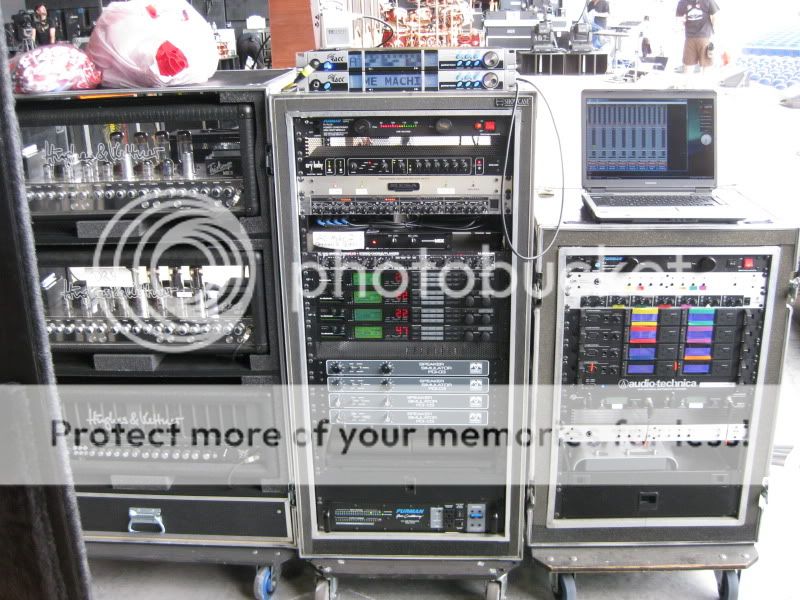
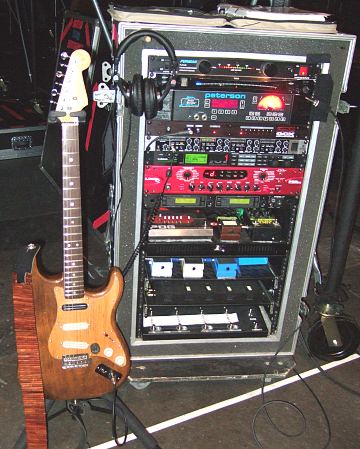
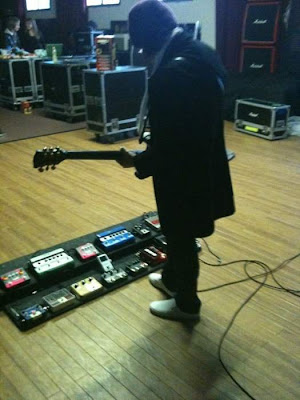
Basically I like to overdrive the speakers just enough so that a little bit of warmth and saturation will begin to happen. Usually it is easier with 10” speakers and old Fenders like the blackface Super Reverb. For overdrives, I’m using two Barber Burn Unit Overdrives which gives me some sustain without too much distortion. I like to keep the metal of the string inside the guitar sound while I have some sustain and that is a little bit tricky to do.
Do you have a preference for either the studio or live environments?
I have a healthy respect for both but I certainly prefer the live environment. I do struggle with the patience factor in a recording studio and always will. I do somehow find it in order to make records. The live environment is a place I completely thrive in and I like everything about it. It is a very exciting environment for me to work in. After forty years on the road I’m finding that I’m enjoying it even more. The only downside now is leaving the home I love and the family I love. That is the only real hardship; being away from my family.
Your online guitar school allows players to actually jam with you?
I started a beginners’ guitar school because I was constantly being told how people who tried to learn guitar usually gave it up in frustration. So I wanted to be a teacher that would help navigate the learning process. So what I try and do for the lessons in the beginners’ course is to show them things that you can do with one finger and no practice. And you can do it now whilst playing along with me. It is just to help people understand the gift of music so they’re engaged and willing enough to do the harder work as we go along.
Are there any plans to re-issue any of the Grin albums?
Sony Legacy put out a Best of Grin which was a great compilation. And they did a great job with it all, and actually called us and asked us to participate and which we did. I regularly approach all the old companies but unfortunately they own all the rights so it’s not my decision. I’ve asked them over and over again about releasing everything but they keep saying no. Those companies have been disappointing as they refuse to put out all the other solo records and refuse to sell me the rights. But I suppose that is how it is for a lot of artists like myself who haven’t had hit records. And unfortunately that was the law of the land back then. You’d sign a record deal and they’d own it.
Interview by Joe Matera
Ultimate-Guitar.Com © 2009
Citation:
You seem to be most closely identified with Fender guitars. Why so?
When I first started playing guitar, I loved Jeff Beck, so I started with a Telecaster, and played that for two years. Then, I gravitated to Jimi Hendrix and the Strat. My favorite old Strats are the ones I’ve been playing for years, both ‘61s. I also have some reissue Strats. I’m a very physical, exuberant player, and Fenders really hold up to a beating. I’ve found that with a Fender, you can lose your finesse and not totally lose it on the instrument, if you can understand that. I like to lean into the guitar and use those five settings you can get out of a Strat. I like playing lots of different guitars, but I’ll always reach for a Strat. It’s the most beautiful electric guitar ever made.
Fender recently has supplied me with some Gretsches, including a couple of Black Falcons and Black Penguins that I use with Bruce. They’re working out well.
I also like playing Jazzmasters onstage with Bruce. When I mix the Jazzmaster with Bruce’s Telecasters or Broadcasters, and Steve Van Zandt’s Strats, it sounds very sympathetic with their guitars. With the Jazzmasters, I use D’Addario 13–56 gauge strings, which are very heavy. That gauge doesn’t “splat,” if you know what I mean. With all the adrenaline pumping onstage, the Jazzmaster, with those strings and the thumb pick, work great.
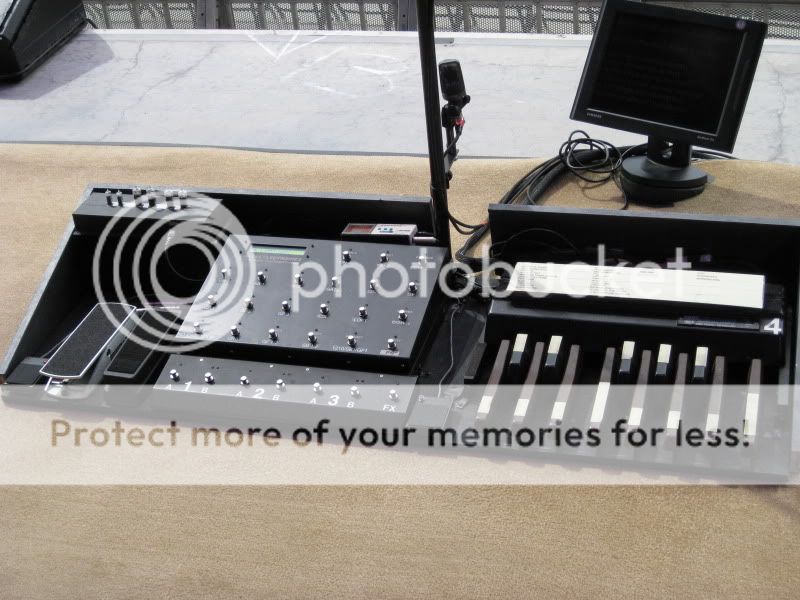
Avec à ses pieds un pédalier Ground Control et les deux overdrives Barber unit.