THE EDGE - The Irish Bell - topic récaptulatif (ou presque)

Rappel du dernier message de la page précédente :
harlock73
eh oui week end oblige ce soir j'ai ete acheter le mag collector U2 , il est excellent , de belles photos et des articles super comme les chansons expliquer par edge etc etc
neozecat
Fonkynico, saches que c'est : au temps pour moi
BENJI63
  • Special Total utilisateur
son accord de mi a edge il fait simplement sonner la corde si comme la corde mi a vide. corde si 5e case.
Starfucker Inc.
Des articles sur le shimmer:

Eno/Lanois Shimmer Sound: How it is made
By seancostello

The basic foundation of the Brian Eno / Daniel Lanois shimmer sound is fairly simple: Create a feedback loop, incorporating a pitch shifter set to +1 octave, and a reverb with a fairly long decay time. By controlling the gain and equalization of the feedback loop, and the lengths of the various delays within the loop, the temporal evolution of the sound can be altered from steel drum-esque sounds to the slow attack “string pads” hear on many of the Eno/Lanois tracks.

Kevin Killen, answering a question about the signal flow on the U2 song “4th of July” on Gearslutz, described the signal path as follows:

The delay and modulation was derived from the AMS 1580. On its fader return , some hi frequencies were rolled off, then it was fed into a 224 Hall setting, probably 5 seconds but with a rolloff in the top and bottom. This return may have been equalised also. We may have added a second delay but then the delays have to be timed to the track as the net effect is blurring the chord progression…Our last tweak would be to play with the sends on all of the returns to the point that its almost recirculating out of control, which in turn is creating a layer upon layer effect.

The AMS DMX 15-80s was a digital delay / sampler / pitch shifter that was in common use in Britain in the early 1980′s. Eno and Lanois have both sung the praises of this unit, and Wendy Carlos has said that the AMS unit had “perhaps the least audible artifacts to pitch shifting available at that time.”

[img]http://valhalladsp.files.wordpress.com/2010/05/ams-dmx-15-80s.png [/img]

David Kulka has written that the AMS DMX had an optional de-glitch card installed, which worked on a similar principle to the auto-correlation deglitcher in the H949. His post is worth quoting:

Harmonizers, at least the early ones, had to electronically “splice” sections of the waveform in order to accomplish pitch change. When the out and in points had different voltage levels, a small DC pop could be heard at each transition. The result was a sort of low level crackle, more obvious with certain kinds of program material, and more audible at extreme pitch change settings.

The Eventide H910 exhibited this, along with the early AMS Harmonizers. Both Eventide (on the H949) and AMS partially resolved this by adding “de-glitch” cards. The circuitry on this card added a “smart” algorithm to pitch change, adjusting the transitions to better match voltages at the in and out points.

The “224 Hall setting” that Killen refers to is the Concert Hall algorithm in the Lexicon 224. This algorithm has a fairly low initial echo density, that builds to a higher density as the decay evolves. The Concert Hall algorithm is also distinguished by its high degree of modulation. The resulting sound is not a terribly accurate simulation of a real concert hall, but rather a lush and spatially expansive reverb that is still sought after more than 30 years after its introduction.

Other accounts of the “shimmer” sound refer to different reverbs being used, such as the EMT250. In addition, modulated delay lines, such as the Lexicon Prime Time, have been used by Lanois at different times. The common elements always seem to be the pitch shifter, a modulated reverb and/or a modulated delay line, and feedback and equalization generated via an analog mixer. In my next post, I will analyze the contributions of these elements to the shimmer sound, and will discuss how the various components respond in a feedback situation.


Shimmer: Modulation, auto-correlation, and decorrelation
By seancostello
In my previous post, I discussed the Eno/Lanois shimmer sound, and how it is based around a pitch shifter and a digital reverb placed in a global feedback loop. It is worth exploring what is going on in this signal chain at the micro level, and how a fairly simple signal routing can create such a complex sound.

The AMS pitch shifter used by Eno and Lanois used a de-glitching board in its architecture, to find the ideal points for splicing together the time-scaled waveform chunks. This presumably worked in a similar manner to the H949 de-glitching card, in that autocorrelation was used to find the most similar segments of the waveform, and the delay time of one of the channels was adjusted for an ideal splice. It is also possible that the auto-correlation would trigger a new splice, such that the rate between splices was a function of the periodicity of the input signal.

Auto-correlation works well for determining splicing points, assuming that the input signal has a certain degree of correlation. A single sustained guitar note, for example, can have a high auto-correlation factor after the initial attack. But what happens when the signal to be shifted has a very low auto-correlation factor? Such a signal is said to be decorrelated; that is, the auto-correlation or cross-correlation is said to be greatly reduced compared to the original signal.

In the audio world, decorrelation often refers to randomization of the phases of the signal while preserving the frequencies, or to a time-varying process to slightly shift the frequencies of a signal to prevent feedback. Both of these processes are present, to a large extent, within time varying reverbs such as the Lexicon 224 and EMT250 used by Eno and Lanois.

The Lexicon 224 Concert Hall algorithm is made up of a number of allpass delays, which preserve the input frequencies while completely scrambling the phase response. In addition, the Concert Hall algorithm uses time varying delays inside of the recursive delay network, which increased the perceived modal density of the reverb, and also impart a beautiful chorusing to the reverb decay. This lushness from time-varying delay lines is very prominent in 1980′s Eno/Lanois productions – in addition to the Concert Hall algorithm and EMT250, they made use of the multi-voice chorus algorithms in the Lexicon units, as well as the Symphonic preset in the Yamaha SPX-90.

So, what happens when a pitch shifter that uses auto-correlation to find the ideal splicing points is put into a feedback loop with a reverb that is highly decorrelated and time-varying? The answer: chaos. The pitch shifter will NOT be able to find ideal splicing points, as the phase of the reverb output is continually being scrambled.

The pitch shifter HAS to splice, whether or not it is a perfect situation, so it will pick the best possible match, but this will probably be a fairly random location each time. The result will be random delays for each new splicing point, or random sizing of the grain windows, depending on how the auto-correlation is used within the pitch shifter. This randomization will cause the sidebands of the input signal to be spread out, such that an individual sinusoid would be turned into a band of frequencies centered around the original (that has been shifted up by an octave).

Add in the additional octaves produced by the feedback, the random sideband spread caused by the modulation within the reverb, and harmonics that are created by analog nonlinearities in the feedback path, and the result is a HUGE amount of sonic complexity generated from a simple system. Put a sine wave into this type of feedback system, and the output can approach near orchestral levels of thickness.

In this light, it is interesting to think about Eno’s use of the DX7 around this time. The DX7 can produce chaotic sounds through the use of cascaded FM, but it can also produce gentle, minimalist textures through the use of parallel operators (sine oscillators). A simple DX7 patch with several parallel sine oscillators and a low FM index may produce a fairly boring sound on its own, but would create an enormous yet controllable sound when fed into a complex feedback loop of digital processing.

Coming up: more on the topic of generating complexity through simple systems with feedback applied to them, both from a technical and creative perspective.
VENTE A PERTE PEDALES ET BAFFLE HAUT DE GAMME

"J'ai l'impression que certains ici ne prennent pas la guitare assez au sérieux... J'en ai surpris en train de s'amuser... Dommage..." - Zepot

FAUVE ? "imiter Thierry Roland qui imite Grand corps malade, c'est pas donné a tout le monde" - Mia Wallace
fonkynico
neozecat a écrit :
Fonkynico, saches que c'est : au temps pour moi


Je ne sais pas du tout,je crois... apparemment qu'on peut écrire les 2
Magic Fingers
neozecat
fonkynico a écrit :
neozecat a écrit :
Fonkynico, saches que c'est : au temps pour moi


Je ne sais pas du tout,je crois... apparemment qu'on peut écrire les 2


Normalement, il faut écrire au temps
http://www.academie-francaise.(...)temps
C'est une expression militaire signifiant qu'un des soldats n'était pas dans le temps en faisant un mouvement, et que l'opération doit être reprise depuis le début. Il reprenait sur le temps ou il s'était trompé. D'où le "au temps pour moi"
fonkynico
neozecat a écrit :
fonkynico a écrit :
neozecat a écrit :
Fonkynico, saches que c'est : au temps pour moi


Je ne sais pas du tout,je crois... apparemment qu'on peut écrire les 2


Normalement, il faut écrire au temps
http://www.academie-francaise.(...)temps
C'est une expression militaire signifiant qu'un des soldats n'était pas dans le temps en faisant un mouvement, et que l'opération doit être reprise depuis le début. Il reprenait sur le temps ou il s'était trompé. D'où le "au temps pour moi"


Bon eh ben... pas de soucis, je vais m'efforcer de l'écrire comme ça dans ce cas
Magic Fingers
coyote
  • Vintage Ultra utilisateur
    Cet utilisateur est un musicien enseignant professionnel
Les deux sont tolérés aujourd'hui, même si c'est plus smart d'écrire "au temps pour moi", un peu comme pour "les haricots verts" en diction, on tolère la liaison entre "les" et "ha" mais c'est tout de même mieux sans. C'est dingue, c'est au moins la 5ème fois que je vois cette question soulevée sur le forum!!
"Have you ever been to Electric Ladyland"

"Il est difficile de vaincre ses passions, et impossible de les satisfaire."

De la pub pour les copains =>
http://www.empty-spaces.fr/
neozecat
Quand on sait qu'au départ ça vient d'un problème de rythme, on ne fais plus l'erreur.
lemg
  • Vintage Ultra utilisateur
  • #4420
  • Publié par
    lemg
    le
Starfucker Inc. a écrit :
Des articles sur le shimmer:

Eno/Lanois Shimmer Sound: How it is made
By seancostello

The basic foundation of the Brian Eno / Daniel Lanois shimmer sound is fairly simple: Create a feedback loop, incorporating a pitch shifter set to +1 octave, and a reverb with a fairly long decay time. By controlling the gain and equalization of the feedback loop, and the lengths of the various delays within the loop, the temporal evolution of the sound can be altered from steel drum-esque sounds to the slow attack “string pads” hear on many of the Eno/Lanois tracks.

Kevin Killen, answering a question about the signal flow on the U2 song “4th of July” on Gearslutz, described the signal path as follows:

The delay and modulation was derived from the AMS 1580. On its fader return , some hi frequencies were rolled off, then it was fed into a 224 Hall setting, probably 5 seconds but with a rolloff in the top and bottom. This return may have been equalised also. We may have added a second delay but then the delays have to be timed to the track as the net effect is blurring the chord progression…Our last tweak would be to play with the sends on all of the returns to the point that its almost recirculating out of control, which in turn is creating a layer upon layer effect.

The AMS DMX 15-80s was a digital delay / sampler / pitch shifter that was in common use in Britain in the early 1980′s. Eno and Lanois have both sung the praises of this unit, and Wendy Carlos has said that the AMS unit had “perhaps the least audible artifacts to pitch shifting available at that time.”

[img]http://valhalladsp.files.wordpress.com/2010/05/ams-dmx-15-80s.png [/img]

David Kulka has written that the AMS DMX had an optional de-glitch card installed, which worked on a similar principle to the auto-correlation deglitcher in the H949. His post is worth quoting:

Harmonizers, at least the early ones, had to electronically “splice” sections of the waveform in order to accomplish pitch change. When the out and in points had different voltage levels, a small DC pop could be heard at each transition. The result was a sort of low level crackle, more obvious with certain kinds of program material, and more audible at extreme pitch change settings.

The Eventide H910 exhibited this, along with the early AMS Harmonizers. Both Eventide (on the H949) and AMS partially resolved this by adding “de-glitch” cards. The circuitry on this card added a “smart” algorithm to pitch change, adjusting the transitions to better match voltages at the in and out points.

The “224 Hall setting” that Killen refers to is the Concert Hall algorithm in the Lexicon 224. This algorithm has a fairly low initial echo density, that builds to a higher density as the decay evolves. The Concert Hall algorithm is also distinguished by its high degree of modulation. The resulting sound is not a terribly accurate simulation of a real concert hall, but rather a lush and spatially expansive reverb that is still sought after more than 30 years after its introduction.

Other accounts of the “shimmer” sound refer to different reverbs being used, such as the EMT250. In addition, modulated delay lines, such as the Lexicon Prime Time, have been used by Lanois at different times. The common elements always seem to be the pitch shifter, a modulated reverb and/or a modulated delay line, and feedback and equalization generated via an analog mixer. In my next post, I will analyze the contributions of these elements to the shimmer sound, and will discuss how the various components respond in a feedback situation.


Shimmer: Modulation, auto-correlation, and decorrelation
By seancostello
In my previous post, I discussed the Eno/Lanois shimmer sound, and how it is based around a pitch shifter and a digital reverb placed in a global feedback loop. It is worth exploring what is going on in this signal chain at the micro level, and how a fairly simple signal routing can create such a complex sound.

The AMS pitch shifter used by Eno and Lanois used a de-glitching board in its architecture, to find the ideal points for splicing together the time-scaled waveform chunks. This presumably worked in a similar manner to the H949 de-glitching card, in that autocorrelation was used to find the most similar segments of the waveform, and the delay time of one of the channels was adjusted for an ideal splice. It is also possible that the auto-correlation would trigger a new splice, such that the rate between splices was a function of the periodicity of the input signal.

Auto-correlation works well for determining splicing points, assuming that the input signal has a certain degree of correlation. A single sustained guitar note, for example, can have a high auto-correlation factor after the initial attack. But what happens when the signal to be shifted has a very low auto-correlation factor? Such a signal is said to be decorrelated; that is, the auto-correlation or cross-correlation is said to be greatly reduced compared to the original signal.

In the audio world, decorrelation often refers to randomization of the phases of the signal while preserving the frequencies, or to a time-varying process to slightly shift the frequencies of a signal to prevent feedback. Both of these processes are present, to a large extent, within time varying reverbs such as the Lexicon 224 and EMT250 used by Eno and Lanois.

The Lexicon 224 Concert Hall algorithm is made up of a number of allpass delays, which preserve the input frequencies while completely scrambling the phase response. In addition, the Concert Hall algorithm uses time varying delays inside of the recursive delay network, which increased the perceived modal density of the reverb, and also impart a beautiful chorusing to the reverb decay. This lushness from time-varying delay lines is very prominent in 1980′s Eno/Lanois productions – in addition to the Concert Hall algorithm and EMT250, they made use of the multi-voice chorus algorithms in the Lexicon units, as well as the Symphonic preset in the Yamaha SPX-90.

So, what happens when a pitch shifter that uses auto-correlation to find the ideal splicing points is put into a feedback loop with a reverb that is highly decorrelated and time-varying? The answer: chaos. The pitch shifter will NOT be able to find ideal splicing points, as the phase of the reverb output is continually being scrambled.

The pitch shifter HAS to splice, whether or not it is a perfect situation, so it will pick the best possible match, but this will probably be a fairly random location each time. The result will be random delays for each new splicing point, or random sizing of the grain windows, depending on how the auto-correlation is used within the pitch shifter. This randomization will cause the sidebands of the input signal to be spread out, such that an individual sinusoid would be turned into a band of frequencies centered around the original (that has been shifted up by an octave).

Add in the additional octaves produced by the feedback, the random sideband spread caused by the modulation within the reverb, and harmonics that are created by analog nonlinearities in the feedback path, and the result is a HUGE amount of sonic complexity generated from a simple system. Put a sine wave into this type of feedback system, and the output can approach near orchestral levels of thickness.

In this light, it is interesting to think about Eno’s use of the DX7 around this time. The DX7 can produce chaotic sounds through the use of cascaded FM, but it can also produce gentle, minimalist textures through the use of parallel operators (sine oscillators). A simple DX7 patch with several parallel sine oscillators and a low FM index may produce a fairly boring sound on its own, but would create an enormous yet controllable sound when fed into a complex feedback loop of digital processing.

Coming up: more on the topic of generating complexity through simple systems with feedback applied to them, both from a technical and creative perspective.


Intéressant, mais je t'avoue ne m'être jamais posé toutes ces questions.

lemgement lemg
harlock73
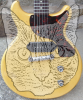
si on se montrais nos grattes pour jouer du U2 moi c'est principalement celle ci , avant j'etait tres strat que ce passe t'il , le manche est super confortable et pas trop gros , les micros sont ceux d'origine donc des epiphone , j'aimerais upgrader mais je sait pas encore par quoi , elle a des straps dorés shaller et une sangle cuir de tres bonne qualiter , meca grover etc ..... celle de edge a un bouton de selecteur blanc et des potard ambre donc a voir aussi quoi que j'aime les noir ... l'etui est un epiphone qui est super , monter en 10/46 D'Addario bright round wound.
voila


fonkynico
J'adore cette gratte, vmt ! Tu as de la chance.
Je crois que je me prendrais bien la même si je n'avais pas déjà une gratte possédant des micros doubles. Là je ne tiens plus, moi qui suis fan du son strat' j'aimerais plutôt investir là dedans mais... l'Explorer, elle est quand même bien typée ça doit donner !
Magic Fingers
neozecat
coyote a écrit :
Les deux sont tolérés aujourd'hui, même si c'est plus smart d'écrire "au temps pour moi", un peu comme pour "les haricots verts" en diction, on tolère la liaison entre "les" et "ha" mais c'est tout de même mieux sans. C'est dingue, c'est au moins la 5ème fois que je vois cette question soulevée sur le forum!!


Citation:
la graphie Autant pour moi est courante aujourd’hui, mais rien ne la justifie.
dixit l'académie
http://www.academie-francaise.(...)temps
fonkynico
Citation:
Citation:
la graphie Autant pour moi est courante aujourd’hui, mais rien ne la justifie.
dixit l'académie
http://www.academie-francaise.(...)temps


Rien à foutre de l'académie Française, je suis Belge
Non mais nous reconnaissons tous ta sagesse et je me plie à cette règle donc, merci de m'avoir corrigé ^^
Magic Fingers
EdgeeeExplorer
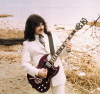
/Photo ZOOTV tour/


Pourquoi son pouce est comme sa ?
"A mon sens, la musique renforce, aussi bien dans la joie que dans le drame, les sentiments"

En ce moment sur effet guitare...